
S1 admission interview · Questions · English part
S1 interview questions 2027:
64 English questions to practise
The common question types from the English part of the S1 admission interview, all in one place. Each question comes with tips, an answer pattern and common mistakes. Tap “Practise” and AI interviewer Mr Chan asks just that question, with instant feedback.
What does the English part of the S1 interview ask?
- A self-introduction
- Personal questions: hobbies, favourite subject, strengths and weaknesses, why this school
- Experience questions: a time you felt proud, failed or worked with others
- Reading a short passage aloud, then a question about it
- Picture description: what are the people doing?
- Situation questions: what would you do?
- Current affairs or opinion questions: your view and your reasons
Every school runs its interview differently, so always check what the school publishes.
Last updated: 26 October 2026
Self-introduction questions
The first question at almost every school. Prepare a 30–60 second version and adapt it to the question.
Q1
Good morning. Please have a seat. Can you introduce yourself in English, please?
Include
name, age or class, school, interests or achievements.
Answer pattern: short connected sentences in present tense
Common mistakes:
- only saying the name
- reciting a long memorised script
Q2
Good morning. Can you tell me about yourself and your family?
Include
name, age or school, family members, one thing the family does together.
Answer pattern: present simple, linking ideas with and / also
Common mistakes:
- only listing family members with no detail
- My family have four people (instead of There are four people in my family)
Q3
Hello. Can you describe yourself in three words?
Include
three different adjectives, an example for at least two of them.
Answer pattern: I would describe myself as ..., ... and ... I am ... because ...
Common mistakes:
- giving three words with no examples
- using very simple words like good, nice, happy
Q4
Please introduce yourself. What should we know about you?
Include
name, class and school, one special skill or fact, an activity they join.
Answer pattern: short connected sentences: My name is ... Something special about me is ...
Common mistakes:
- I am study in P6 (am + verb)
- reciting a long memorised script
Q5
Please tell me your name and one thing that makes you special.
Include
name, class, one special thing, a short explanation or story behind it.
Answer pattern: My name is ... One thing that makes me special is that ...
Common mistakes:
- giving a special thing with no explanation
- only saying the name and class
Q6
Good morning. How did you come here today? And can you introduce yourself?
Include
how they came, name, age or school, interests.
Answer pattern: I came here by ... My name is ... I study at ...
Common mistakes:
- I come here by MTR (present instead of past)
- by foot (instead of on foot)
Q7
Imagine it is your first day at secondary school. How would you introduce yourself to your new classmates?
Include
a friendly greeting, name, primary school, interests, a friendly ending.
Answer pattern: friendly tone: Hello everyone! My name is ... I hope ...
Common mistakes:
- sounding like a formal script
- no friendly ending
Q8
Can you tell me about yourself in about half a minute?
Include
name, age, where they live or their family, two interests.
Answer pattern: short connected sentences, about thirty seconds
Common mistakes:
- speaking for too long
- I am twelve years (missing old)
Personal questions: hobbies, subjects, strengths
The interviewer wants to get to know you. Give a reason and one specific example in every answer.
Q9
Why do you want to study in our school?
Include
at least one specific reason about the school, a personal link or interest.
Answer pattern: I want to ... because ...
Common mistakes:
- Because it is good (no detail)
- talking only about the building
Q10
What are your strengths and weaknesses?
Include
one strength with an example, one weakness, how they improve the weakness.
Answer pattern: My strength is that ... My weakness is that ..., but ...
Common mistakes:
- no example
- saying there is no weakness
Q11
What do you like to do in your free time?
Include
a hobby, when or how often they do it, a specific example, why they enjoy it.
Answer pattern: I like ... because ... For example, ...
Common mistakes:
- only naming the hobby
- I very like drawing (word order)
Q12
Which subject do you like the most, and which one do you find difficult?
Include
favourite subject with a reason, difficult subject with a reason, how they try to improve.
Answer pattern: My favourite subject is ... because ... The most difficult subject for me is ...
Common mistakes:
- Because it is fun (no detail)
- I am not good in Maths (instead of good at)
Q13
Can you recommend a book you like to us?
Include
the title, a short summary, why they like it, who would enjoy it.
Answer pattern: I would like to recommend ... It is about ... I like it because ...
Common mistakes:
- retelling the whole story
- not remembering the title
Q14
Who is your role model, and why?
Include
who the person is, a quality they admire, a specific example, how the person influences them.
Answer pattern: My role model is ... He / She ... He / She teaches me that ...
Common mistakes:
- choosing a famous person but knowing nothing about them
- He is very good (no detail)
Q15
Tell me about your primary school. What will you miss the most?
Include
a short description of the school, what they will miss, a reason.
Answer pattern: My primary school is ... I will miss ... the most because ...
Common mistakes:
- only saying my school is good
- I will miss my teacher very much (no reason)
Q16
What would you like to be in the future, and why?
Include
a job or goal, a reason or experience behind it, what they will do to reach it.
Answer pattern: I would like to be ... because ... To reach my goal, I will ...
Common mistakes:
- I want to be doctor (missing a)
- no plan for how to reach the goal
Q17
What do you know about our school, and which activity would you like to join here?
Include
a specific fact about the school, an activity they want to join, a reason linked to themselves.
Answer pattern: I know that your school ... If I study here, I would like to ... because ...
Common mistakes:
- Your school is very famous (no detail)
- naming an activity the school does not have
Q18
How do you balance your studies and your free time?
Include
a specific method, an example of their routine, the result.
Answer pattern: I ... First, I ... and then I ... This helps me ...
Common mistakes:
- I study hard and play (too general)
- no example of their routine
Experience questions: tell a short story
Use three steps: what happened, what you did, what you learned.
Q19
Tell me about a time when you felt proud of yourself.
Include
what happened, why they felt proud, what they learned.
Answer pattern: short past story: I felt proud when ... At first ... In the end ...
Common mistakes:
- only naming a prize with no story
- using present tense for a past event, e.g. Last year I win a prize
Q20
Can you share a time when you failed at something? What did you learn?
Include
what happened, how they felt, what they did next, the lesson learned.
Answer pattern: past story: In P5, I ... I felt ... After that, I ... I learned that ...
Common mistakes:
- choosing an example that is too small or not real
- no lesson at the end
Q21
Tell me about a time you worked in a team. What was your role?
Include
the task, their own role, a problem and how they solved it, the result.
Answer pattern: Last year, we ... My role was to ... Sometimes ..., so we ... In the end ...
Common mistakes:
- talking only about we without their own role
- saying there were no problems at all
Q22
Tell me about a time when you helped someone.
Include
who they helped, what they did, the result or how they felt.
Answer pattern: Last term, ... I ... In the end ...
Common mistakes:
- a very general answer like I always help people
- no result or feeling
Q23
Do you have any duties at home or at school? Tell me about them.
Include
a duty at home or at school, what they do and how often, what they learn from it.
Answer pattern: At home, I ... At school, I am ..., so I ... These duties teach me ...
Common mistakes:
- I help my mum (no detail)
- I am responsible for clean the table (missing -ing)
Q24
Have you ever been a leader? What did you learn from it?
Include
the leadership role, what they had to do, a challenge, what they learned.
Answer pattern: Yes, I was ... I had to ... At first ..., but I learned that ...
Common mistakes:
- saying no and stopping there
- only listing duties with no lesson
Reading aloud passages and passage questions
Read silently first, notice new words and pauses, then read clearly. Afterwards the interviewer asks a question about the passage.
Q25 · Passage · Interview Set 1
Last summer, our class visited a farm in Yuen Long. We picked fresh vegetables and learned how farmers grow food without chemicals. It was hot, but everyone worked together. At the end of the day, we cooked a simple lunch with the vegetables we had picked.
Practise reading →
Q26
Thank you. What did the students do at the farm, and what do you think they learned?
Include
picked vegetables, cooked lunch, a reasonable lesson (hard work, teamwork, food without chemicals).
Answer pattern: They ... I think they learned that ...
Common mistakes:
- copying a whole sentence from the passage
- no opinion
Q27 · Passage · Interview Set 2
Every March, our school holds a Reading Week. Students bring old books from home and swap them with friends in the library. Last year I gave away three comic books and got a story about a girl who lived on Lamma Island. After reading it, I really want to visit the island myself one day.
Practise reading →
Q28
Thank you. What do students do during Reading Week, and do you think a book swap is a good idea?
Include
bring old books from home, swap them with friends in the library, an opinion about book swaps with a reason.
Answer pattern: During Reading Week, students ... I think ... because ...
Common mistakes:
- copying a whole sentence from the passage
- only answering yes or no
Q29 · Passage · Interview Set 3
When Typhoon Signal Number Eight was raised last September, all schools were closed. The wind was very strong and the rain hit our windows all morning. My family stayed at home and played board games. In the afternoon, I helped my mother check that we had enough food, water and batteries for the night.
Practise reading →
Q30
Thank you. Why were the schools closed, and do you think schools should close on typhoon days?
Include
Typhoon Signal Number Eight was raised, an opinion about closing schools with a reason (safety).
Answer pattern: The schools were closed because ... I think ... because ...
Common mistakes:
- answering only the second part
- no reason for the opinion
Q31 · Passage · Interview Set 4
On a sunny Saturday, our Scout group joined a beach clean-up in Sai Kung. We wore gloves and picked up plastic bottles, straws and old fishing nets. In just two hours, we filled twenty bags. A worker told us that rubbish in the sea can hurt turtles and fish. Now I always bring my own bottle.
Practise reading →
Q32
Thank you. What did the Scouts pick up at the beach, and how can we keep the sea clean?
Include
plastic bottles, straws, old fishing nets, at least one practical way to keep the sea clean.
Answer pattern: They picked up ... I think we can ... by ...
Common mistakes:
- copying the whole passage
- giving an idea with no explanation
Q33 · Passage · Interview Set 5
Our school Sports Day took place at Wan Chai Sports Ground. Before the relay race, my heart was beating fast. When the baton came to me, I ran as fast as I could. We did not win, but our classmates cheered loudly for us. After the race, we shared drinks and laughed together on the grass.
Practise reading →
Q34
Thank you. What happened in the relay, and do you think winning is the most important thing in sports?
Include
the team did not win, classmates cheered for them, an opinion about winning with a reason.
Answer pattern: In the relay, ... I think / I do not think ... because ...
Common mistakes:
- retelling every sentence
- no opinion
Q35 · Passage · Interview Set 6
Last Christmas, our class visited an elderly home in Kwun Tong. We sang songs, played simple games and gave cards we had made to the grandmas and grandpas. One old lady held my hand and told me stories about Hong Kong in the past. When we left, she smiled and asked us to visit again soon.
Practise reading →
Q36
Thank you. What did the students do at the elderly home, and why do you think visits like this are important?
Include
sang songs, played games, gave cards, a reason why visits matter.
Answer pattern: They ... I think these visits are important because ...
Common mistakes:
- copying the passage word for word
- no reason
Q37 · Passage · Interview Set 7
On the night of the Mid-Autumn Festival, my family went to Victoria Park to see the lanterns. There were rabbits, fish and even a giant moon made of light. We ate mooncakes on the grass and tried to guess the lantern riddles. My little brother fell asleep in my father's arms before we went home.
Practise reading →
Q38
Thank you. What did the family do at Victoria Park, and do you think festivals like this are still important today?
Include
looked at lanterns, ate mooncakes, guessed riddles, an opinion about festivals with a reason.
Answer pattern: They ... I think festivals are ... because ...
Common mistakes:
- answering only the first part
- a reason that is too general, like because it is fun
Q39 · Passage · Interview Set 8
At our school Science Fair, my partner and I built a small robot that could sort rubbish into paper, plastic and metal. On the first try, it dropped everything on the floor. We changed the program three times. In the end, it worked, and many visitors stopped to watch it. I felt proud of our hard work.
Practise reading →
Q40
Thank you. What could the robot do, and why do you think the students did not give up?
Include
sort rubbish into paper, plastic and metal, a reasonable reason for not giving up.
Answer pattern: The robot could ... I think they did not give up because ...
Common mistakes:
- The robot can sorting rubbish (verb form)
- no reason for the second part
Picture description questions
Say where it is, then what each person is doing (present continuous), then add a detail or a feeling.
Q41
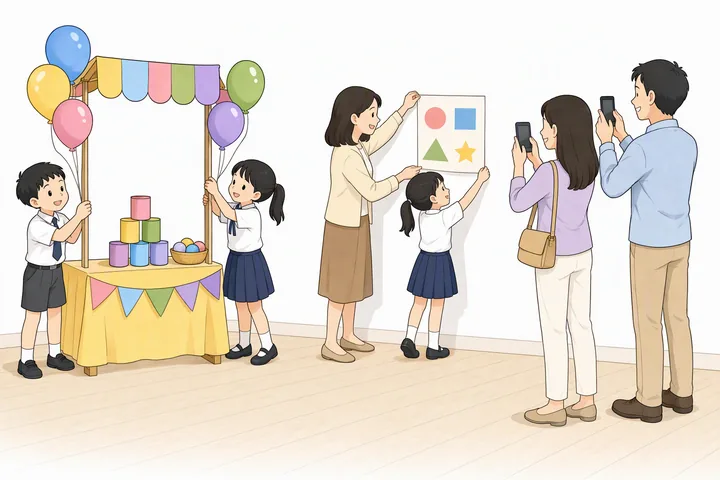
Please look at the picture. What are the people doing?
Include
school open day, children setting up a booth, teacher helping with a poster, parents taking photos.
Answer pattern: present continuous: is/are + -ing
Q42
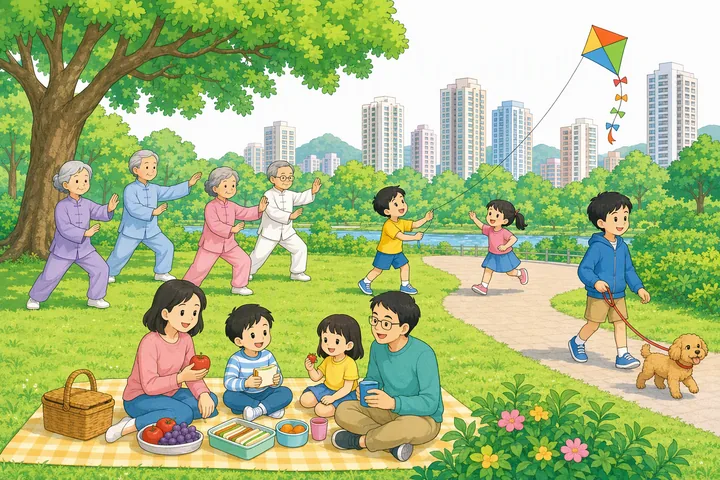
Here is a picture of a park. Can you describe what you see?
Include
a park on a Sunday, grandparents doing tai chi, children flying a kite, a boy walking a dog, a family having a picnic.
Answer pattern: present continuous: is/are + -ing, with place words like under, on, next to
Q43
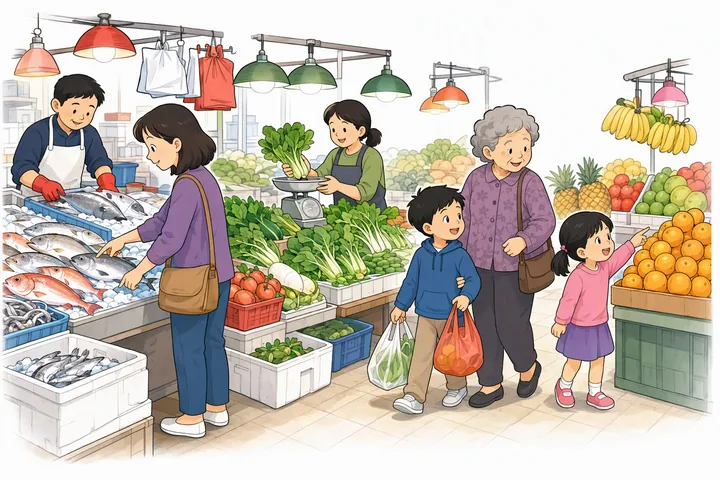
Look at this picture. Tell me what is happening.
Include
a wet market in the morning, a woman choosing fish, a seller weighing vegetables, a boy carrying bags for his grandmother, a girl pointing at oranges.
Answer pattern: present continuous: is/are + -ing
Q44
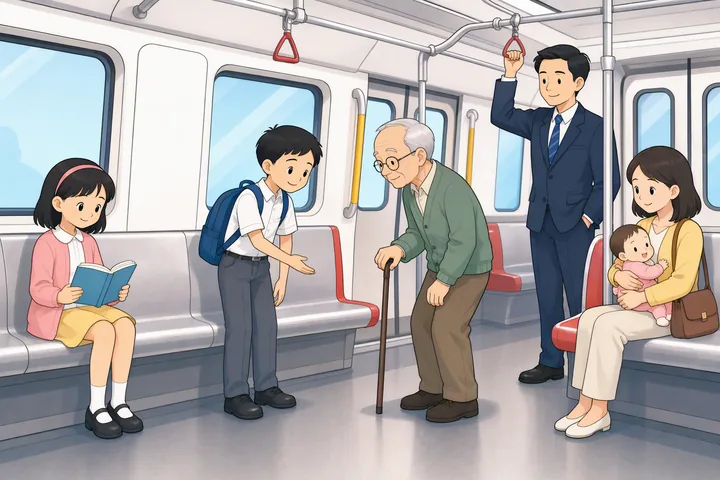
Please describe this picture to me.
Include
an MTR train, a boy giving his seat to an old man, a girl reading, a man holding the handrail, a mother holding a baby.
Answer pattern: present continuous with place words: This picture shows ... A boy is ...
Q45
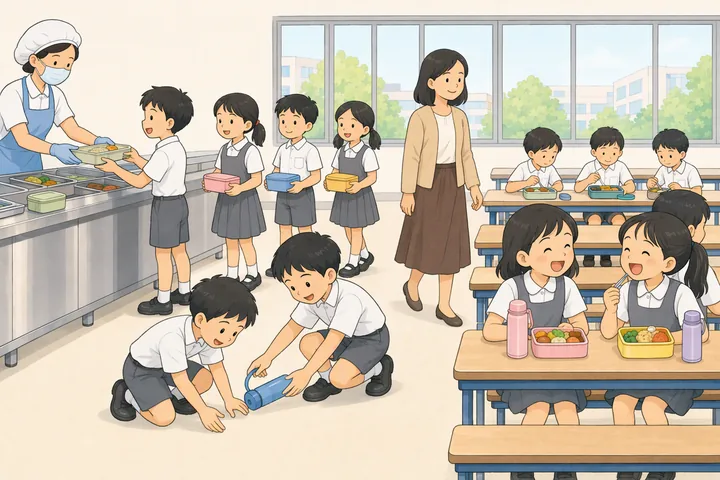
Look at the picture. What can you see?
Include
a school hall at lunchtime, students queuing, a friend helping a boy pick up a bottle, a teacher walking around, two girls chatting.
Answer pattern: present continuous: is/are + -ing
Q46
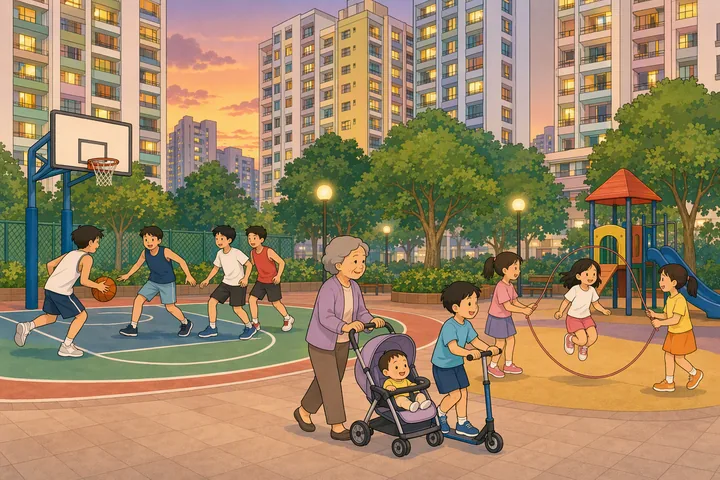
Please look at this picture and tell me what the people are doing.
Include
a playground in a housing estate, teenagers playing basketball, a grandmother pushing a pram, a boy riding a scooter, girls skipping.
Answer pattern: present continuous: is/are + -ing, linked with and / while
Q47
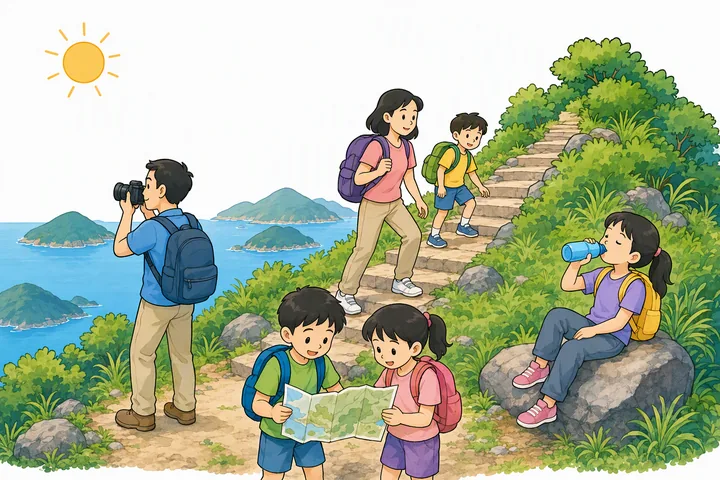
Here is a picture of some people on a hiking trail. Can you describe it?
Include
a hiking trail with the sea behind, a family walking up steps, a man taking a photo, children looking at a map, a girl resting and drinking water.
Answer pattern: present continuous with There is / There are for the background
Q48

Please look at this picture. What are the people doing?
Include
a flower market before Chinese New Year, a family choosing an orange tree, a seller wrapping flowers, children holding windmills, a grandfather carrying peach blossoms.
Answer pattern: present continuous: is/are + -ing
Situation questions
Say what you would do and why, and show you care about how others feel.
Q49
If you saw your good friend cheating in a test, what would you do?
Include
a clear action, a reason, consideration for the friend or fairness.
Answer pattern: I would ... because ...
Common mistakes:
- I will tell teacher (no reason)
- only saying 'I don't know'
Q50
Imagine you find a wallet on the floor of an MTR station. What would you do?
Include
a clear action (hand it to staff or police), a reason (honesty), thinking about the owner.
Answer pattern: I would ... so that ... because ...
Common mistakes:
- only saying one word like police
- keeping the money because nobody saw
Q51
Imagine you are doing a group project, but one member never does his part. What would you do?
Include
talking to the member first, offering help, a next step if it does not work, a reason (fairness).
Answer pattern: First, I would ... If ..., I would ... because ...
Common mistakes:
- blaming the classmate without talking first
- I will scold him (no kind solution)
Q52
If you could be the principal of your school for one day, what would you change?
Include
one or two realistic changes, who they help, a reason.
Answer pattern: If I were ..., I would ... so that ... I think ...
Common mistakes:
- unrealistic ideas like no school forever, with no reason
- If I am principal, I will ... (mixing conditionals)
Q53
Imagine you and your best friend both want to be class representative. What would you do?
Include
a clear decision, how they keep the friendship, fair competition, what they would do if they lose.
Answer pattern: I would ... but first I would ... If ..., I would ...
Common mistakes:
- giving up without a reason
- I will make her lose (unkind answer)
Q54
Suppose you borrowed a classmate's calculator and broke it by accident. What would you do?
Include
telling the truth, saying sorry, a way to make up for it, a reason.
Answer pattern: I would ... Then I would ... I think ... because ...
Common mistakes:
- hiding the problem
- only saying sorry with no solution
Q55
Your best friend's birthday party and an important school competition are on the same day. What would you do?
Include
a clear choice, a reason, how they make it up to the other side.
Answer pattern: I would ... because ... But I would ...
Common mistakes:
- I don't know (no decision)
- choosing without any reason
Q56
If you saw some students laughing at a younger student in the playground, what would you do?
Include
a calm action to stop it, caring for the younger student, getting help from a teacher, a reason.
Answer pattern: I would ... Then I would ... I think ...
Common mistakes:
- doing nothing because it is not my business
- fighting with the students
Current affairs and opinion questions
Give a clear view, two reasons and an example, then sum up.
Q57
Have you heard any news recently, in Hong Kong or around the world? Tell me about it and what you think.
Include
a real news topic, a short summary, an opinion with a reason.
Answer pattern: Recently I read/heard that ... I think ... because ...
Common mistakes:
- no opinion
- a topic they cannot explain
Q58
Some people think students should not have homework during school holidays. What do you think?
Include
a clear position, at least two reasons or both sides, a short conclusion.
Answer pattern: I agree / disagree ... because ... On the other hand ... So I think ...
Common mistakes:
- only saying I agree
- Holiday no need homework (missing verb)
Q59
Some people say children under twelve should not use social media. Do you agree?
Include
a clear position, at least one danger or benefit, a reason or example, a possible solution.
Answer pattern: I agree / disagree because ... But ... For example, ...
Common mistakes:
- talking only about games, not social media
- giving no reason
Q60
Do you think online lessons are as good as lessons in the classroom?
Include
a clear position, a benefit of classroom lessons, a benefit or problem of online lessons, a conclusion.
Answer pattern: I think ... is better because ... However, ...
Common mistakes:
- only saying online is boring
- no comparison between the two
Q61
Many children spend hours on screens every day. How much screen time do you think is healthy?
Include
a clear amount or position, a health reason, a suggestion or personal example.
Answer pattern: I think ... is enough because ... We should also ...
Common mistakes:
- only saying screens are bad
- no example or suggestion
Q62
Some people think PE lessons are not as important as English and Maths. Do you agree?
Include
a clear position, at least two reasons, a conclusion.
Answer pattern: I agree / disagree. Firstly, ... Also, ... So ...
Common mistakes:
- only saying PE is fun
- I am disagree (extra am)
Q63
Should students be allowed to bring mobile phones to school?
Include
a clear position, a benefit, a problem, a suggested rule.
Answer pattern: I think ... However, ... So the school could ...
Common mistakes:
- only saying phones are bad
- no suggestion
Q64
Hong Kong has had many very hot days in recent summers. Have you heard any news about this, and what can we do?
Include
a related news item, a possible cause, one or two practical actions.
Answer pattern: I heard on the news that ... I think ... We can help by ...
Common mistakes:
- no actions, only saying it is hot
- a reason they cannot explain
How are answers scored?
Mikoe follows the four domains commonly used in the HKEAA TSA speaking assessment: Ideas & Organisation, Vocabulary & Language, Pronunciation & Delivery, and Communication Strategies, each scored 0 to 4.
How can parents help?
- Practise 2–3 questions a day rather than 20 the night before.
- Let your child say the answer out loud instead of writing and memorising it.
- Start with the self-introduction and “why our school”: they come up most often.
- Listen back to the recording together and find where one more example would help.
FAQ
What questions are asked in the S1 interview?
Common question types in the English part are: a self-introduction, personal questions (hobbies, subjects, strengths and weaknesses, why this school), experience questions, reading a passage aloud with a question about it, picture description, situation questions, and current affairs or opinion questions. Every school is different, so check what the school publishes.
Are there sample answers?
Every question on this page has tips, an answer pattern and common mistakes. After your child answers with “Practise”, if the answer can still improve, Mr Chan gives a sample answer built from your child's own idea, plus tips.
Does every school ask the same questions?
No. The questions on this page were written by Mikoe for practice, based on common question types. They are not real questions from any school.
How should my child prepare for reading aloud?
Read silently once, noticing new words and where sentences pause, then read slowly and clearly. Mikoe scores reading on pronunciation and fluency.
How do you answer a picture description question?
Say where it is, describe what each person is doing in the present continuous (for example, The children are flying a kite), then add one detail or a feeling.
Are there group discussion questions?
For now, Mikoe covers the English individual interview. Group discussion will come later.
How many questions should we practise each day?
Two or three a day is enough. What matters is saying each answer out loud and trying again after the feedback.
The questions on this page were written by Mikoe for practice, based on common question types; they are not real questions from any school. Mikoe is an independent Edtools product and is not affiliated with the Education Bureau, the HKEAA or any school.

Start with one question
Pick a question to practise, or try a full mock interview of about 8 minutes.
Try a full mock interview